How AI Search for B2B Lead Generation Is Changing the Buyer Journey
AI search isn't replacing search-driven B2B lead generation. It's adding a discovery and validation layer on top of it. Here's how buyers now move from being found to being recommended, and what it takes to stay visible.
 >
// 360Presence · From Ranking to Recommendation
>
// 360Presence · From Ranking to Recommendation
A procurement lead at a mid-market company needs a logistics partner. He opens Google, like always. But this time he also opens an AI assistant and types: which companies solve this, how do the main options compare, and what should I actually look for. Within minutes he has a shortlist, a rough sense of who's credible, and a set of questions, none of which came from your website, and some of which may have named your competitors and not you.
That scene is now ordinary. The place where brand visibility happens is expanding. It used to sit almost entirely inside search rankings. Today it's spread across search engines, AI assistants, reviews, industry publications and the wider web, and a large part of it happens before a buyer ever contacts a vendor. This is the real story behind AI search for B2B lead generation: not a new channel to bolt on, but a change in what being visible even means.
We should be clear up front about what this is not. AI is not replacing Google. SEO is not dead. And appearing in an AI answer is not the same thing as generating a lead. What's actually happening is more useful, and more manageable, than the hype suggests.
Why AI Visibility Matters for B2B Lead Generation
AI visibility is a simple idea: when a buyer describes a problem to an AI system, does your company surface as part of the answer? For years, the equivalent question was whether you ranked on the first page of Google. That question still matters. But it's no longer the only place a buyer forms an early opinion of who's worth considering.
This matters for B2B specifically because of how B2B deals are actually researched. Buying groups are large, cycles are long, and most of the evaluation happens quietly. Gartner's research has consistently found that a majority of the B2B buying journey now happens without direct vendor contact, with buying groups of six to ten stakeholders each arriving with their own independently gathered information. If AI-assisted research shapes that early picture, then being absent from it means being absent from conversations you never see.
Being visible is becoming more than ranking a page. It's being credible enough to be part of the answer.
How AI Search Is Changing the B2B Buyer Journey
B2B buyers have always researched before they buy. What's changed is that they now have a research assistant that answers instantly, never pushes back, and doesn't care which vendor wins. So they use it, alongside everything else. Gartner's 2026 buyer research found that around 45% of B2B buyers used AI during a recent purchase, and that buyers weighed roughly seven different information sources before making a decision. AI is one of those sources, not a replacement for the rest.
In practice, buyers move between search engines, AI assistants, company websites, reviews, industry publications, third-party mentions, social platforms and professional communities, often in a single afternoon, and rarely in a straight line. The journey loops between exploring, evaluating and validating rather than marching down a tidy funnel.
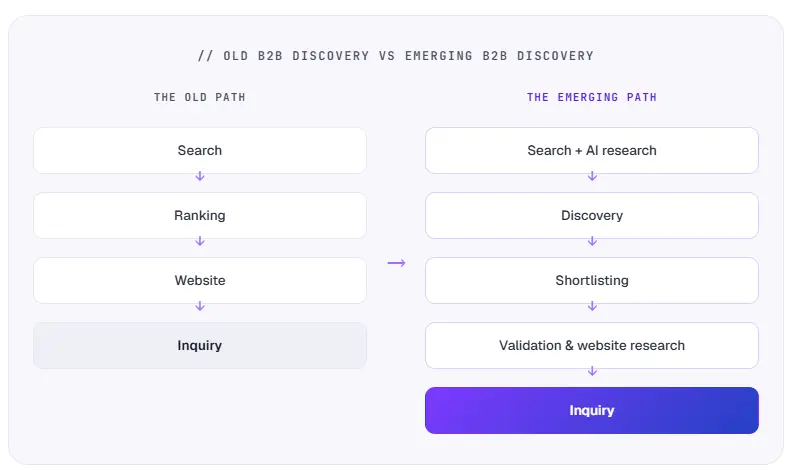
The important shift is where the shortlist gets formed. In the old path, you earned consideration by ranking a page and getting the click. In the emerging path, a brand can be surfaced, compared and roughly ranked during AI-assisted research before the buyer ever lands on the site. That's the same thinking behind why your website isn't generating leads: the decisive moments increasingly happen upstream of the pages you control.
The ReframeFrom Being Found to Being Recommended
Traditional SEO answers the question "how do I rank for this term?" AI search asks a different one: "when someone describes this problem, is my brand part of the answer?" Those are related, but they are not identical, and the gap between them is where a lot of B2B brands are quietly losing ground.
Being found is passive. A buyer goes looking, and if you rank, you're there. Being recommended is different. It means the research itself surfaces you, carries a sense of what you do, and hands the buyer a reason to trust you before they've read a word on your site. You don't fully control that moment, but you influence it, through the same signals that make any brand credible: clarity about what you do, and consistent presence across the places buyers and AI systems both look.
When a buyer asks an AI system who can solve this problem, the brands in the answer aren't necessarily the ones with the biggest ad budget. They're the ones the wider web already treats as credible.The Two Fundamentals
Why Some Businesses Appear in AI Search While Others Don't
When we look at which brands surface in AI-assisted research and which don't, the pattern comes down to two fundamentals. Neither is a trick. Both are things a business can actually build.
Website hygiene & optimization
If the business itself is hard to understand online, it becomes harder for both discovery systems and buyers to understand what the company does.
- Technical health, crawlability and indexability
- Clear information architecture and content structure
- Unambiguous service and product information
- Topical relevance and consistent business details
- A genuinely usable experience
Internet-wide brand authority
A company exists digitally far beyond its own website. AI visibility is not only a website problem. It is also an authority problem.
- Credible third-party mentions and PR
- Industry publications and authoritative sites
- Relevant directories, reviews and partnerships
- Professional communities and genuine references
- Consistent brand information across all of them
Foundation 01 — Website hygiene & optimization
This is not a generic technical checklist. The strategic point is understanding. AI systems, and buyers, both need to grasp quickly what your company does, who it's for, and why it's credible. A site that's slow, disorganised, or vague about its own offering makes that hard. When your own website can't clearly state what you do, you can't expect a discovery system to state it for you.
Foundation 02 — Internet-wide brand authority
The second fundamental is harder and more decisive. AI systems tend to surface brands that are referenced across the wider web, not just brands that publish a lot on their own domain. Ahrefs' study of 75,000 brands found that branded web mentions correlated with AI-Overview visibility far more strongly than backlinks did, with mentions roughly three times stronger as a predictor. The researchers were careful to note that correlation is not causation: brands that get mentioned across credible sources also tend to be real brands that invested in quality and earned coverage. But the direction is clear. Publishing volume alone doesn't build AI visibility. Earned presence does.
To be clear about what this does not mean: it is not a licence for spammy link schemes or manufactured mentions. Authority that AI systems and buyers actually trust is earned through real coverage, real reviews and real partnerships, the same way reputation has always been built, just now with a wider audience reading it.
The Honest AnswerWhy SEO Still Matters in the Age of AI Search
Does SEO still matter if people use AI? Yes. And the reasons are practical, not sentimental.
First, buyers haven't abandoned search, they've added AI to it. Gartner's own data shows AI as one of several sources buyers consult, not the only one. Second, the qualities that make a page rank well, clarity, structure, topical relevance and credible references, are largely the same qualities that make content easy for an AI system to understand and surface. Investing in SEO improves both. Third, different AI systems source information in different ways. Yext's analysis of millions of AI citations found that engines like Gemini, ChatGPT and Perplexity have distinct sourcing preferences, some leaning on structured, brand-owned pages, others on reviews and expert sources. There is no single AI ranking factor to game, which is exactly why broad, durable fundamentals matter more than tactics.
AI search isn't replacing SEO. It's changing what being visible means.
How AI Search Is Creating a New Layer of B2B Lead Generation
The clearest way to see the change is as an added stage in how demand forms. It runs roughly like this:
// AI search to B2B lead generation journey
// Visibility is an input near the start. The inquiry still depends on everything after it.
This matters most for high-consideration purchases, exactly the kind B2B runs on: vendor research, early-stage discovery, and the formation of a consideration set. A brand that surfaces during AI research can enter that set earlier, before the buyer has visited the site or spoken to anyone.
But here is the discipline that keeps this honest. AI visibility is not the same thing as lead generation. Surfacing in research is an input to demand, not a guarantee of it. Whether that early visibility ever becomes an inquiry still depends on the website, the offer, the trust signals and the wider growth system. A citation is not a lead. Treating it as one is how businesses fool themselves with a vanity metric.
CitationsHow AI Citations Can Influence B2B Brand Discovery
An AI citation is a reference: when an AI system surfaces or points to a brand while answering a buyer's question. Citations matter because they're a proxy for the thing that actually drives discovery, whether the wider web treats your brand as a credible answer to a given problem. The more consistently credible sources reference you in the right context, the more likely you are to be part of the answer when it counts.
We're seeing this play out in our own work. 360Presence has started working on AI research and visibility with roughly five B2B brands, and one example stands out.
// 360Presence client observation
In one logistics engagement, the brand has been cited more than 500 times and has generated approximately 3 to 5 leads per month attributed to AI-driven discovery or research. This is a specific 360Presence client observation, not an industry benchmark, an average, or a guarantee. Results depend on the business, the market and the wider growth system, and the numbers will not transfer directly to another company.
We share it not as a promise but as an early signal of the pattern this whole article describes: when a brand becomes genuinely credible across the places buyers and AI systems look, it starts showing up in research it wasn't showing up in before, and some of that visibility, handled well, turns into real conversations.
DefinitionsWhat AI Search Optimization Actually Means for B2B Brands
AI search optimization is easy to misread as a fresh bag of tactics. It isn't. It's an extension of things that already define whether a business is discoverable and credible: search visibility, website quality, topical relevance, brand authority and trust. AIO doesn't discard any of that. It applies the same fundamentals to a wider set of places buyers now research.
So the honest version of AI search optimization for a B2B brand is not "ten tricks to appear in ChatGPT." It's making your business genuinely easy to understand and genuinely credible, on your own site and across the web, so that whatever surface a buyer researches on, the picture they get is clear, consistent and trustworthy. That's slower than a hack and far more durable. It also compounds, which is why we treat AI optimization as infrastructure rather than a campaign.
The ModelSEO + AIO: Building a Combined Search Visibility Strategy
The way we think about it at 360Presence is that these pieces are layers of one system, not competing bets. Each does a distinct job, and the business outcome comes from the whole stack working together.
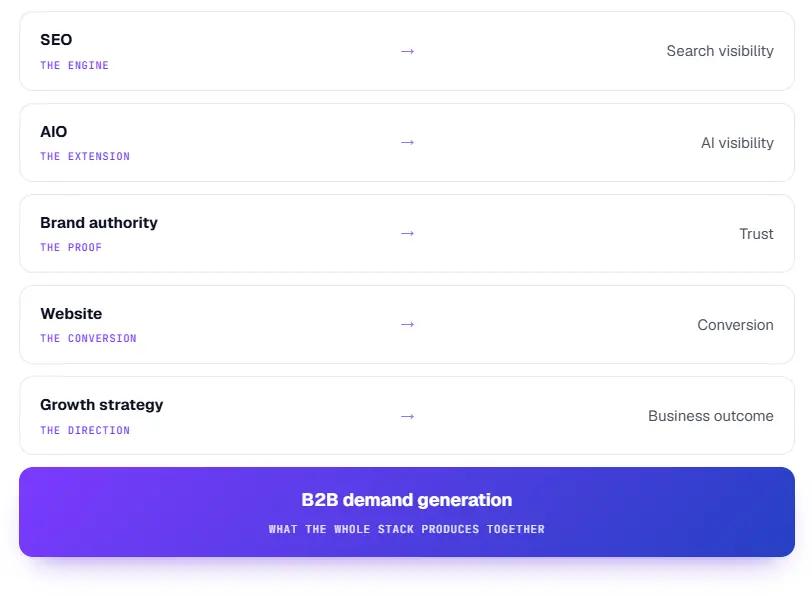
Read as a single line: SEO earns search visibility, AIO extends it into AI visibility, brand authority converts visibility into trust, the website turns trust into conversion, and growth strategy points the whole thing at a business outcome. Pull one layer out and the others weaken. This is the same principle behind why marketing is an investment, and behind our belief in strategy before you spend on marketing: the parts only pay off as a connected system.
AIO isn't SEO's replacement. It's the next layer of search visibility, built on the same foundations of clarity, relevance and credibility.
The Future of B2B Lead Generation Isn't Just About Ranking
Platforms will keep changing. The way AI systems retrieve and present information will keep evolving, and no single technique will stay reliable for long. What won't change is the underlying requirement. Buyers, and the tools they research with, gravitate toward brands that are clear about what they do and credible in the eyes of the wider web.
So the strategic question for any B2B brand is no longer only "do I rank?" It's this:
When a buyer asks an AI system who can solve this problem, is my company credible enough to be part of the answer?
Being visible was always the goal. Now being visible isn't enough on its own. The brands that win the early, invisible part of the B2B journey are the ones credible enough to be recommended, not just found. That's the work: fix the fundamentals on your own site, build genuine authority across the web, and connect that visibility to an actual business outcome rather than a citation count.
// TL;DR
- AI search adds a discovery and validation layer to B2B research. It doesn't replace search.
- Buyers now blend search, AI, reviews and websites, often before contacting any vendor.
- The shift is from being found to being recommended.
- Two fundamentals drive AI visibility: website hygiene and internet-wide brand authority.
- SEO still matters, and its foundations feed AI visibility. AIO is the next layer, not the replacement.
- Visibility is not a lead. A citation is an input to demand, not a guarantee of it.
Is your brand part of the answer?
Most businesses don't know whether AI-assisted research surfaces them or their competitors. 360Presence builds the visibility infrastructure, website hygiene, brand authority and search foundations, that puts you in the consideration set earlier.