Why Your Website Isn't Generating Leads (And How to Turn It Into a Growth Engine)
Most businesses think they have a traffic problem. In reality, they have a website that leaks every visitor it earns. Here's what's actually happening, and how to fix it.

If your website isn't generating leads, the instinct is to buy more traffic. More ads. More SEO. More social. But the honest answer, after auditing hundreds of business websites, is that most sites don't have a traffic problem. They have an infrastructure problem. The traffic arrives and quietly leaks away.
Think about what that means. You are already paying to bring people to a page that was never built to turn them into leads. Every extra visitor just makes the leak bigger. Fixing the website first is the cheapest growth you will ever buy, because you convert the traffic you already have instead of renting more of it.
This is the same thinking behind everything we do at 360Presence, and it's why we wrote Marketing Isn't Magic, It's an Investment. Marketing amplifies what already exists. If the website underneath is weak, marketing just spreads the weakness faster.
Why Your Website Isn't Generating Leads Even If You Have Traffic
Traffic does not equal leads
Traffic is a vanity number until it converts. A site can pull thousands of visitors a month and produce almost nothing, because getting someone to the page and getting them to act are two completely different jobs. The first is a marketing job. The second is an infrastructure job. Most businesses invest heavily in the first and ignore the second.
The hidden cost of a poor website
The cost of a website not generating leads is invisible, which is exactly why it's dangerous. You don't get an alert when a visitor leaves. You just see a flat lead count and assume you need more reach. Meanwhile the leak compounds. A one-point lift in conversion, from say 2% to 3%, is a 50% increase in leads from the exact same traffic. That's the money already sitting on your site.
What the data says about website conversions
The benchmarks tell a blunt story. Most websites convert somewhere between 1% and 4% of visitors, and for B2B lead generation a form or demo page landing between 2% and 5% is considered solid. The median B2B conversion rate across industries sits around 2.9%. Put simply: for most businesses, 96 to 98 out of every 100 visitors leave without doing anything. The question isn't how to get more of the 100. It's why so few of them convert.
More traffic to a leaky site isn't growth. It's a faster way to lose people.
The Biggest Website Conversion Problems Businesses Ignore
Across industries, the same website conversion problems show up again and again. None of them are exotic. That's what makes them easy to overlook and expensive to leave alone.
Slow website speed
Speed is the first filter, and most sites fail it. Google's research found that more than half of mobile visitors abandon a page that takes longer than three seconds to load, and the probability of a bounce climbs 32% as load time moves from one second to three. A one-second delay alone can cut conversions by around 7%. If your site is slow, the rest of this list barely matters, because most people never see it.
Weak messaging
Most sites talk about the company. Visitors care about themselves. If a first-time visitor can't tell what you do, who it's for, and why it matters within a few seconds, they leave. First impressions form in well under a second, and the vast majority of that judgment is about clarity and design, not the depth of your copy. Vague headlines are one of the quietest killers of leads.
Poor mobile experience
Mobile is where the leak is worst. It drives most of the traffic but a fraction of the conversions. Contentsquare's 2026 benchmark shows mobile generating around 58% of traffic but only 40% of revenue, largely because mobile converts at roughly half the desktop rate. A site that looks fine on your laptop but fights the user on a phone is losing the majority of its audience by default.
No clear calls to action
If a visitor has to hunt for what to do next, they won't. Every page needs one obvious action. When you offer five equal options, you effectively offer none, because you've handed the decision back to a stranger who came to you for direction.
No trust signals
People don't hand over their details to a business they don't trust yet. Reviews, case studies, client logos, real results and clear guarantees do the quiet work of reassurance. Baymard Institute research across dozens of sites found that trust signals lifted conversion by roughly 15% to 30% on average when placed where the visitor feels the risk. A blank, claim-free page asks for a leap of faith most visitors won't take.
Complicated forms
The form is where intent goes to die. Every extra field is another reason to quit, and each field beyond a few measurably drops completion. A visitor motivated enough to reach your contact form is your warmest lead of the day. Asking for a phone number, company size, budget and a paragraph of detail before you've earned any of it throws that warmth away.
Poor navigation
Confusing navigation makes people work, and working visitors leave. A large majority judge a site's quality by how easy it is to move around. If your menu is a maze, the exit is the easiest thing to find.
Slow speed
Half of mobile visitors gone before the page even appears.
Weak messaging
Nobody understands what you do in the seconds you get.
Broken mobile
The majority of traffic fights the layout and leaves.
No clear CTA
Visitors don't know what to do, so they do nothing.
No trust
No proof means no reason to hand over details.
Heavy forms
Too many fields turn warm intent into abandonment.
Signs Your Website Is Not Generating Leads
You don't need a full audit to spot a website not generating leads. The symptoms are visible in your own analytics if you know what to look at.
Notice what every one of these has in common. None of them is fixed by more traffic. They're all downstream of how the site is built.
The Core MistakeWhy Most Business Websites Behave Like Digital Brochures
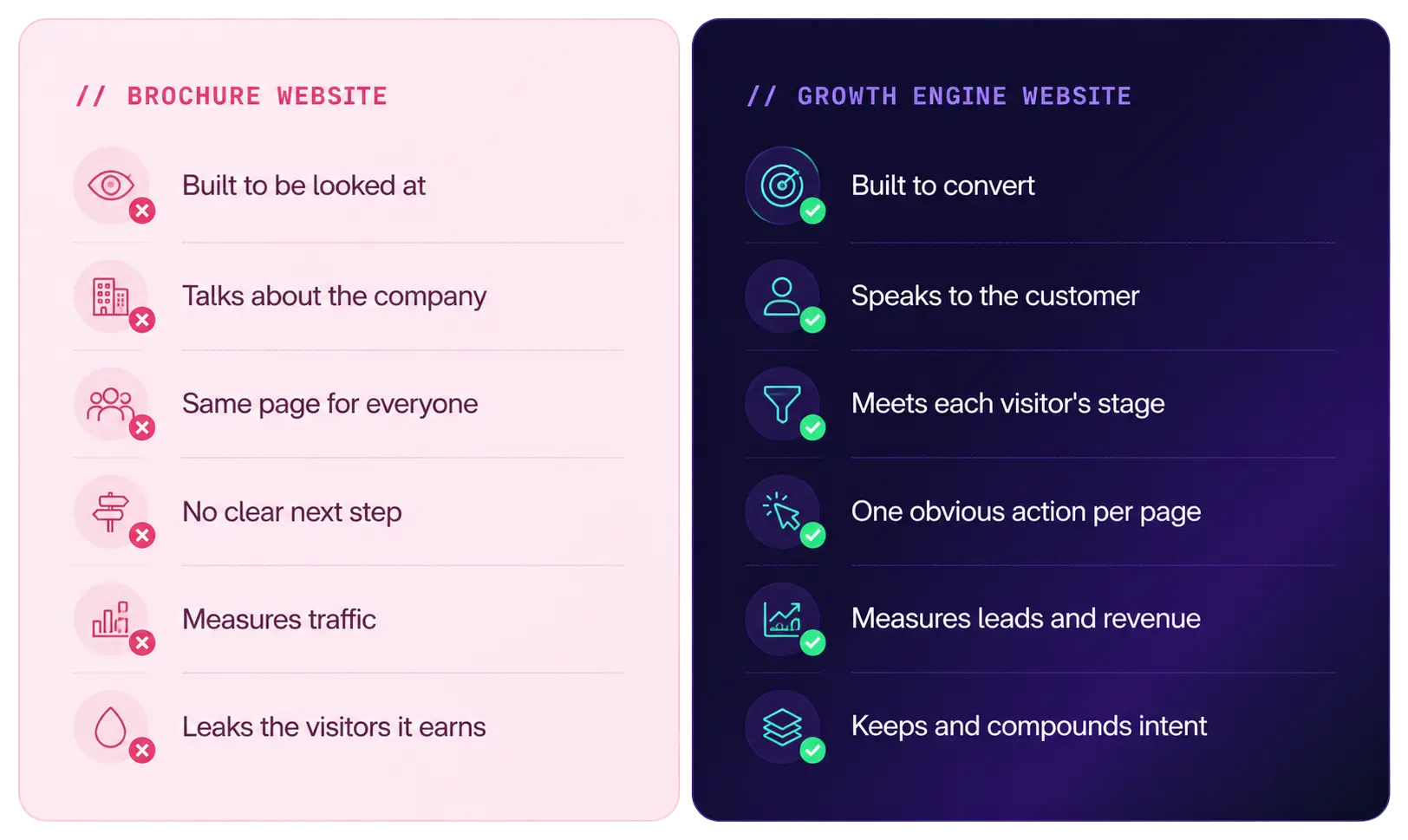
Here's the root of it. Most websites were built to be looked at, not to do a job. They're digital brochures: a polished description of the business that sits there and waits. A brochure informs. An engine converts. Those are different machines built for different outcomes.
Beautiful design without strategy
A gorgeous site with no conversion logic is an expensive painting. Design should guide a visitor toward a decision, not just impress them. Beauty without direction is decoration, and decoration doesn't generate leads.
No customer journey
Visitors arrive at different stages. Some are ready to buy, most are just looking. A brochure treats them all the same. An engine meets each one where they are and moves them one honest step forward.
No conversion architecture
Conversion architecture is the deliberate structure that carries a visitor from arrival to action: the order of the message, the placement of proof, the single clear next step on every page. Most sites have layout. Very few have architecture. That gap is exactly where leads are lost.
A brochure describes your business. An engine grows it. Most companies are paying engine money for a brochure.The Fix
Website Lead Generation Strategy That Turns Visitors Into Customers
A real website lead generation strategy isn't a redesign. It's a system where each part has a job and the parts reinforce each other. These are the pieces that consistently move the number.
Say what you do, who it's for and why it matters, instantly. Clarity beats cleverness every time.
Speak to the visitor's problem, not your feature list. Copy should lead toward a decision.
Reviews, case studies, results and logos placed exactly where hesitation happens.
Dedicated pages built for one offer and one action convert far harder than a general homepage.
Trade real value, a guide, audit or tool, for contact details and capture intent earlier.
You can't fix what you can't see. Track where visitors drop off, then fix that exact spot.
SEO architecture
All of this assumes the right people are arriving in the first place. That's the role of SEO: not traffic for its own sake, but qualified visitors with real intent. And as search shifts toward AI answers, being discoverable inside ChatGPT, Perplexity and Google's AI Overviews through AI Optimization is becoming part of the same foundation. Good architecture brings in people who were already looking for what you do, which is the traffic most likely to convert.
You don't need more visitors. You need a system that keeps the ones you earn.
The Growth Engine Framework
This is how we think about turning a website into a growth engine at 360Presence. Not a list of tactics, but a path. Every visitor should move through six stages, and every page on your site should have a clear job at one of them. When a stage is missing, that's where your leads leak out.
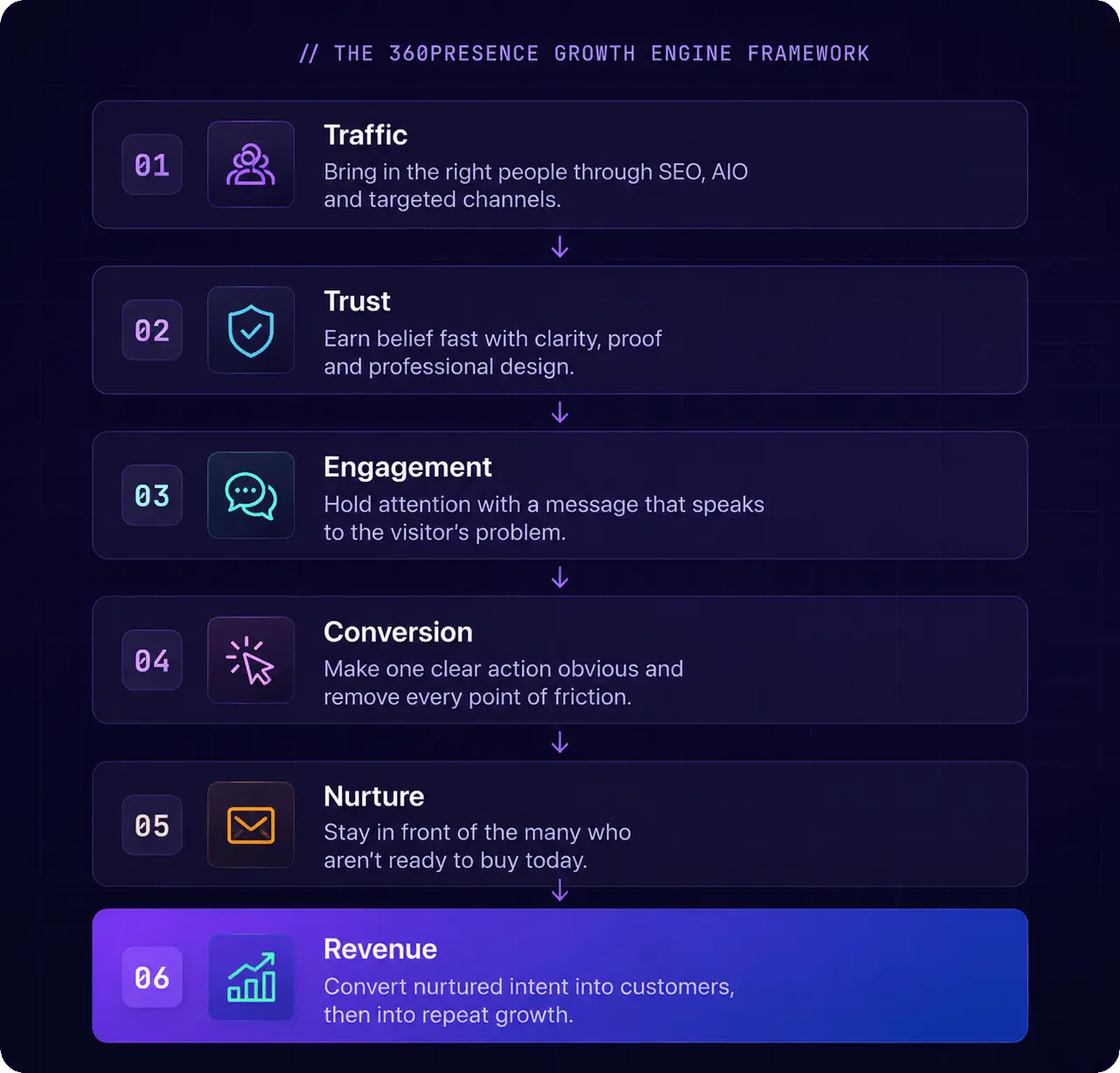
A brochure stops at trust, if it gets that far. A growth engine runs the whole path. The difference between the two isn't budget. It's whether the site was engineered or just designed.
How 360Presence Builds Websites That Generate Leads
We start where most agencies finish. Before a single page is designed, we look at what the business is trying to achieve, where growth is breaking, and what the site actually needs to do. That diagnosis-first approach is the same one behind how we think about growing a business: strategy before spending, always.
Then we build. Website development at 360Presence means engineering the full path, positioning, messaging, trust, mobile, speed, forms and conversion architecture, as one connected system rather than a set of pretty pages. The goal isn't a website that wins design awards. It's a website that generates leads while you sleep.
We don't build websites. We build growth infrastructure.
Why your website isn't generating leads is almost never a traffic problem. It's an infrastructure problem, and infrastructure is something you can build.
// TL;DR
- Most sites don't have a traffic problem, they have a website that leaks leads.
- The usual culprits: slow speed, weak messaging, poor mobile, no clear CTA, no trust signals, heavy forms.
- Lifting conversion one point (2% to 3%) means 50% more leads from the same traffic.
- Most websites are brochures. Leads come from an engine with conversion architecture.
- The fix is a system: traffic, trust, engagement, conversion, nurture, revenue.
- We don't build websites. We build growth infrastructure.
Most businesses don't need more traffic
They need a website that converts the traffic they already have. 360Presence builds growth infrastructure that turns websites into revenue-generating assets.