How to Grow a Business: A Strategy Before Spending on Marketing
Most owners try to grow a business by spending faster. The ones who actually scale do something slower and smarter first: they build the strategy and the systems before they touch the ad budget.

Here is the short answer most agencies will not give you: you do not grow a business by spending more on marketing. You grow it by building something worth marketing, then putting fuel on it.
That distinction sounds small. It is the difference between businesses that compound and businesses that burn through budget and wonder where it went.
Every week, owners ask some version of the same question. Should we run ads? Should we invest in SEO? Should we redesign the website? They are good questions. They are also the wrong place to start. The honest version of how to grow a business begins one step earlier, with a decision about strategy before a single rupee or dollar goes into a campaign.
The uncomfortable truth about growth
Building a business is hard, and the data is blunt about it. According to the U.S. Bureau of Labor Statistics, roughly one in five new businesses closes within the first year, close to half are gone within five years, and about 65% do not make it to ten.
of new businesses close within their first year
// U.S. BLSare gone within five years
// U.S. BLSdo not survive to the ten-year mark
// U.S. BLSNow the part that matters for anyone trying to grow your business: these companies rarely die from a lack of marketing. When CB Insights analysed hundreds of startup post-mortems, the single most common cause founders named was no real market need, cited in roughly 42% of failures. Running out of cash shows up near the top too, but that is usually the final symptom, not the disease. The bank account empties because not enough people wanted to pay for what was built.
Marketing was almost never the thing that failed. The thing that failed was building or promoting something before confirming people genuinely needed it.
Read that pattern again, because it reframes the whole question. If the leading cause of failure is a strategy problem, then more marketing spend cannot be the cure. You would simply be paying to show a weak offer to more people, faster.
Cause and EffectHow to grow a business without wasting money on marketing
Marketing is an amplifier. That is its job, and it does it well. The problem is that amplifiers do not care what they amplify. Point one at a strong offer and growth compounds. Point one at a broken funnel and you scale the leak.
Picture two businesses spending the same amount on ads.
// Same spend, opposite outcomes
Same channel. Same budget. Completely different result. The variable was never the marketing. It was everything sitting underneath it.
This is why the smartest first move when you want to scale your business is not to open an ad account. It is to find the one place your growth is actually breaking and fix it. Sometimes that is the product. Sometimes it is pricing. Very often it is the website doing a poor job of turning visitors into enquiries, which is exactly where solid website development earns its keep before any traffic campaign runs.
Before approving any ad budget, ask one question: if traffic doubled tomorrow, would the business convert it? If the honest answer is no, spend on the system first.
Why every business growth strategy starts before marketing
A business growth strategy is not a marketing plan with a bigger title. A marketing plan answers how you reach and convert customers. A growth strategy answers something broader: how the whole business is designed to create, deliver and keep value. Marketing is one component inside it, not a substitute for it.
When you treat marketing as the entire growth plan, you quietly hand your fate to a single lever. When you treat it as one part of a connected system, you build something far harder to knock over.
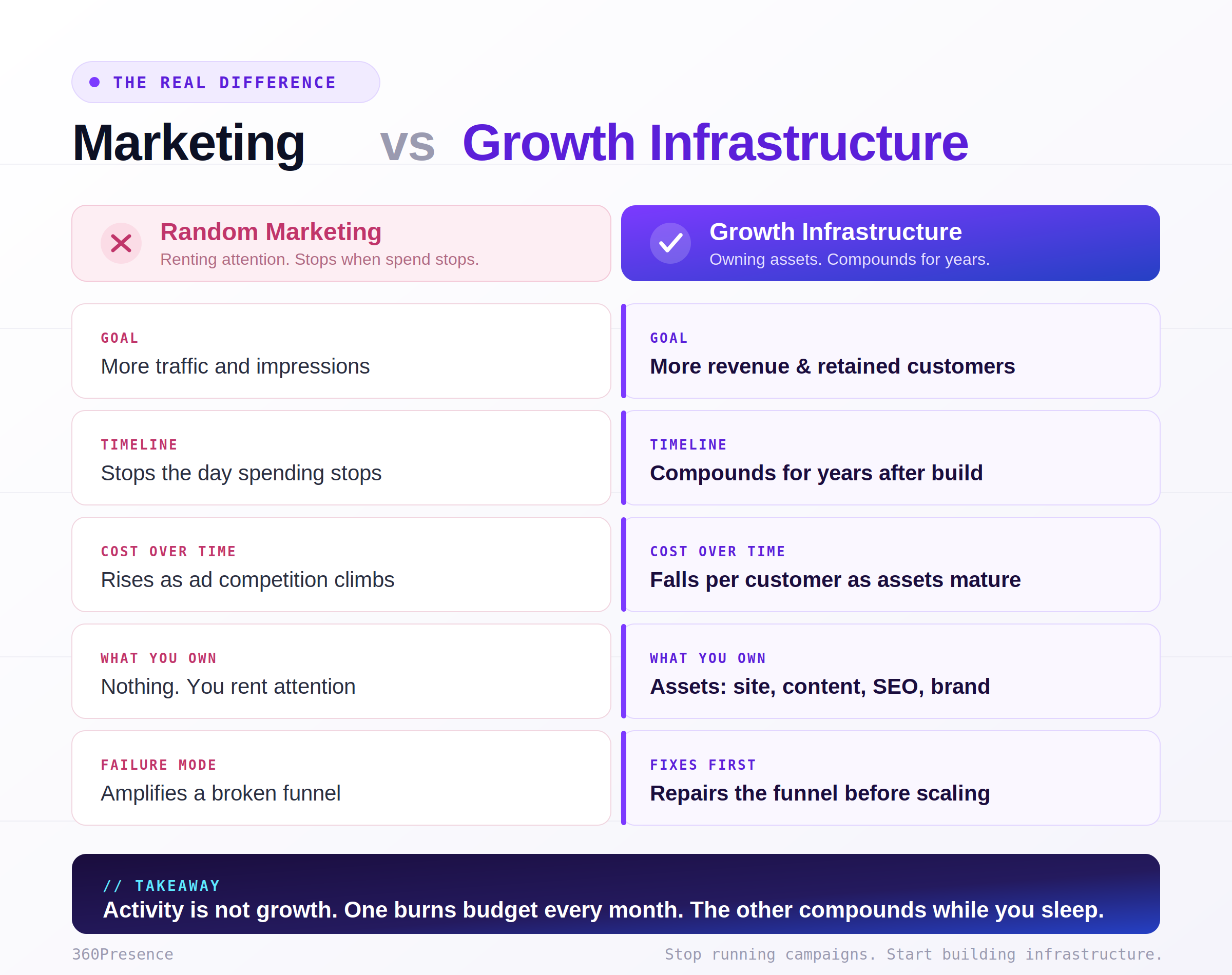
The difference shows up clearly when you put the two mindsets side by side.
| Dimension | Marketing-only mindset | Growth infrastructure mindset |
|---|---|---|
| Starting point | Which channel should we run? | Where is growth actually breaking? |
| Time horizon | This month's leads | Compounding over quarters and years |
| Core unit | The campaign | The system |
| When results dip | Switch channel or agency | Diagnose the constraint and fix it |
| What it builds | Spikes of attention | An asset that keeps producing |
This is the entire reason 360Presence was built around growth infrastructure rather than campaigns. Businesses did not need another vendor selling a channel. They needed someone to diagnose the actual constraint before prescribing a solution.
Prescribing ads, SEO or a redesign before understanding the business is like prescribing medicine before diagnosing the patient.
A real business marketing strategy only works once it sits on top of a healthy system. Get the order wrong and you are optimising the volume of a message that was not ready to be heard.
The MethodHow to scale your business through systems instead of campaigns
Campaigns end. Systems keep working. That single difference is why some businesses plateau the moment they stop spending while others keep growing in their sleep.
A campaign is a burst. You fund it, it runs, it stops, and the results stop with it. A system is an asset. You build it once, maintain it, and it produces compounding returns long after the initial work. The goal when you scale your business is to convert as much of your growth as possible from bursts into assets.
A burst of paid ads
Leads flow while the budget runs. Pause the spend and the pipeline goes quiet the same week.
Organic search visibility
Content and SEO that keep ranking and bringing qualified traffic month after month, without paying per click.
A one-off promotion
A discount spikes sales briefly, then demand falls back, sometimes lower than before.
A retention engine
Onboarding, follow-up and customer experience that turn one purchase into repeat revenue and referrals.
Search is a useful example of how fast the ground is shifting. People now ask ChatGPT, Perplexity and Google's AI overviews for recommendations, not just the classic ten blue links. Being discoverable inside those answers is becoming its own discipline, which is why AI optimization is moving from a nice-to-have to part of core infrastructure. The platforms change. The principle does not: build assets that keep working, do not just rent attention.
Campaigns rent attention. Systems own it.
The growth infrastructure framework
Durable growth is not one thing done brilliantly. It is several connected things done consistently. Think of it as a stack: marketing sits on top, but it can only amplify what the layers beneath it deliver.
// Marketing amplifies. The six layers below decide what gets amplified.
Each layer answers a question that marketing cannot answer for you:
- Product — does what you sell solve a real, painful problem well enough that people choose it over the alternatives?
- Pricing — does the price reflect the value and the margin you need to grow, or are you quietly subsidising every sale?
- Positioning — is it instantly clear who this is for and why it is different? Strong branding lives here.
- Sales — once someone is interested, is there a reliable path that turns interest into a paying customer?
- Customer experience — does the experience after purchase match the promise that brought them in?
- Retention — do customers come back and tell others, or do you have to keep buying brand-new ones to stand still?
Marketing applied to a strong stack is leverage. Marketing applied to a weak stack is expensive noise. That is the whole thesis behind how we approach growth at 360Presence: engineer the system, then amplify it.
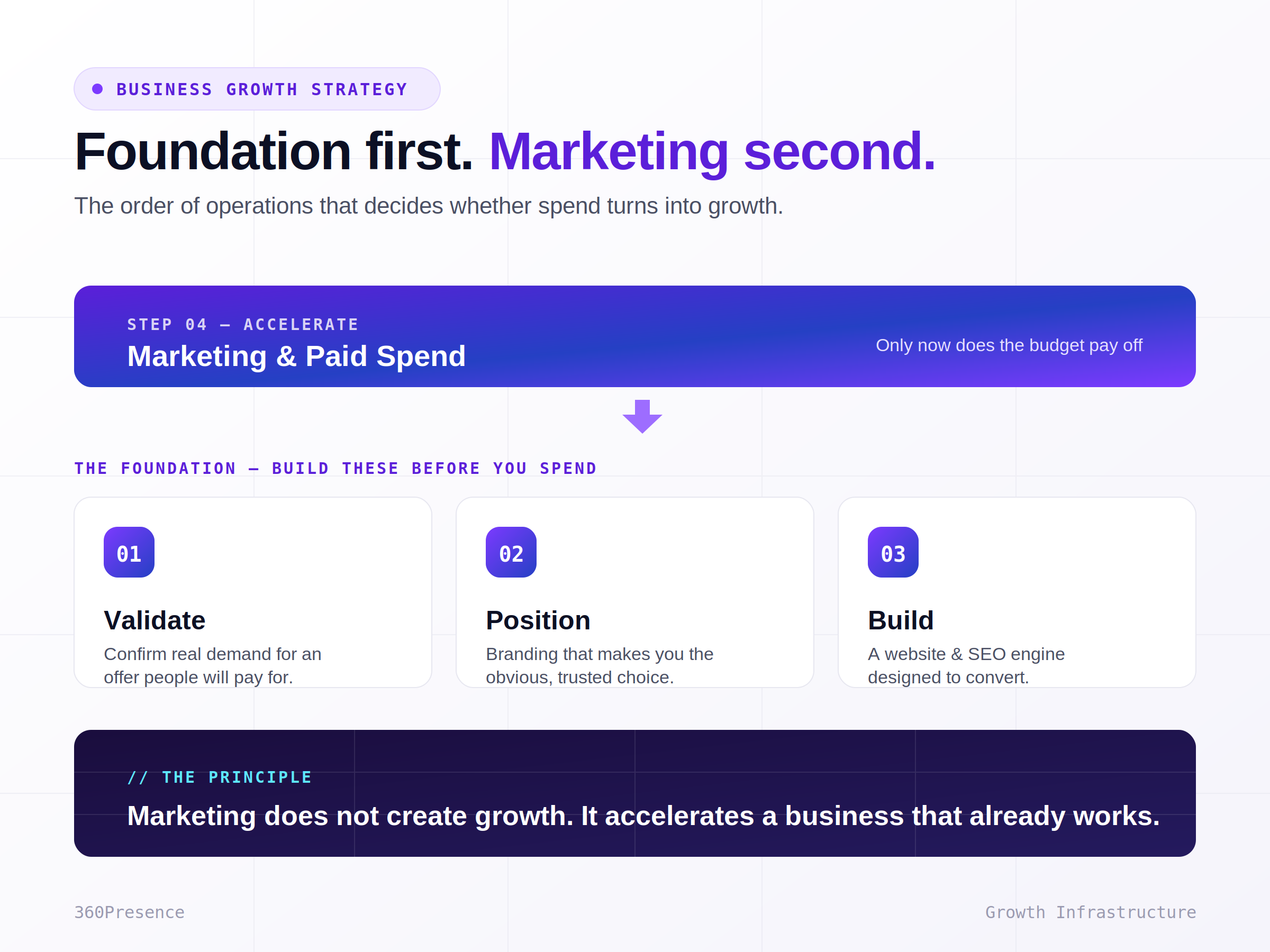
A practical roadmap to grow your business
Theory is easy to nod along to and hard to act on. Here is the sequence we use to move a business from guesswork to a working growth engine. The order matters more than the speed.
Map the funnel from first touch to repeat purchase and find the single biggest leak. Most owners assume it is traffic. It is usually conversion, pricing or retention. Name the real constraint before spending a thing.
Since no market need sinks roughly 42% of failed companies, prove people will pay before you scale. Talk to actual buyers, not friends. Treat a willingness to pay as the only signal that counts.
Your website, messaging and positioning are where interest becomes revenue. A clear site that loads fast and explains the value will out-earn a bigger ad budget pointed at a confusing one.
Now invest in the channels that compound — organic search, content, visibility inside AI answers — and use paid marketing to accelerate what is already converting, not to rescue what is not.
Pick a few honest metrics, keep the strategy steady long enough for systems to mature, and resist the urge to reset every quarter. Consistency is where compounding actually happens.
Diagnose, validate, fix the conversion surface, then amplify. Spend on marketing only when it is accelerating something that already works.
Mistakes that quietly kill business growth
Most growth does not die in a dramatic moment. It leaks out slowly through avoidable mistakes that feel productive at the time.
// Avoid these
- Spending before diagnosing. Funding ads while the funnel leaks just buys faster disappointment.
- Treating marketing as the whole strategy. One lever is a fragile way to carry a business.
- Chasing immediate results. Growth compounds. Expecting week-one returns guarantees frustration.
- Switching agencies and channels too fast. Every reset throws away the momentum the last one was building.
- Confusing activity with progress. Building and posting feel productive even when nobody has confirmed they want what you are selling.
- Ignoring retention. Buying new customers to replace ones you keep losing is the most expensive way to stand still.
Notice the thread running through all of them: each one is a strategy or systems mistake wearing a marketing costume. Fix the order and most of these stop happening on their own.
Before You SpendYour pre-marketing growth checklist
Run through this before approving any growth budget. If you cannot tick most of these, that is where the work is.
// Strategy before spend
- We know the single biggest constraint on our growth right now.
- We have evidence, not just hope, that people will pay for this.
- Our website turns interested visitors into enquiries reliably.
- It is instantly clear who we are for and why we are different.
- We have a repeatable path from interested to paying.
- Existing customers stay, return or refer.
- We are investing in at least one channel that compounds, not only paid bursts.
- We have agreed to hold the strategy steady long enough to judge it fairly.
Stop running campaigns. Start building infrastructure.
// TL;DR — How to grow a business
- Growth is a strategy problem before it is a marketing problem. Decide before you spend.
- Most businesses fail from no real market need (~42% of cases), not weak ads.
- Marketing amplifies the system underneath it — strengthen that first.
- Scale through systems that compound, not campaigns that stop when the budget does.
- Follow the order: diagnose, validate, fix conversion, then amplify.
- Hold a consistent strategy long enough for it to compound.
Build the system, then scale it
If you want to grow your business on infrastructure instead of one-off campaigns, let's start by diagnosing where your growth is actually breaking — before you spend another rupee on marketing.